

Posted At: Aug 05, 2026 - 14 Views

Small and medium enterprises contributed 22.9% of Saudi GDP in 2024, the most recent reading in the Vision 2030 Annual Report published in April 2026, against a 2030 target of 35%. Closing twelve points in four years is a management-capability problem before it is a finance or regulation problem, and capability resolves, more often than owners admit, into a single recurring decision: who gets to run the business next.
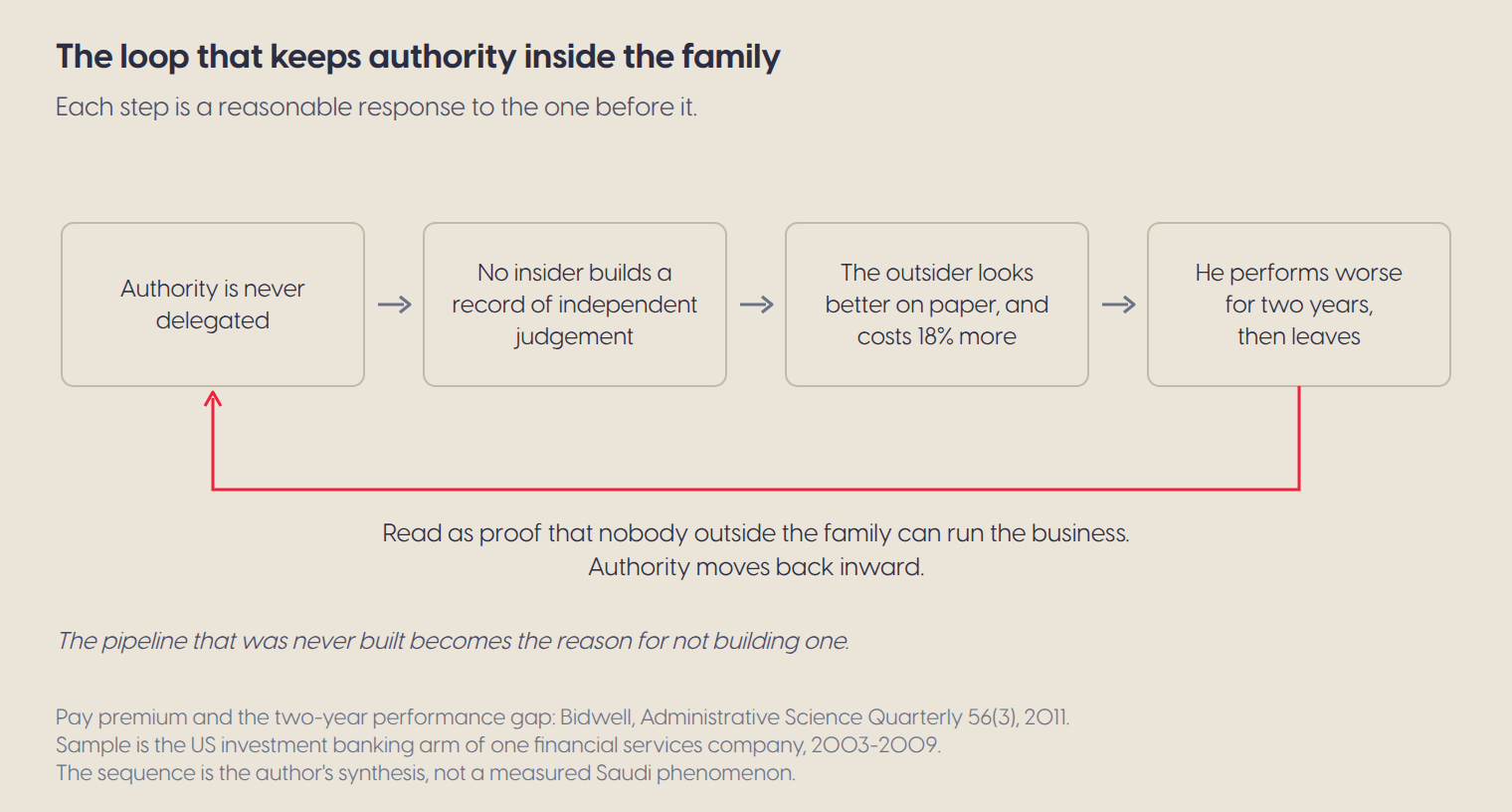
The pattern runs like this. The family knows every weakness of the general manager who has been with them eleven years, because they have watched him execute their instructions and seen where he falters. They know nothing of the candidate the search firm has produced, whose weaknesses sit behind a résumé, a list of achievements and a well-run second interview. They hire the stranger. When it does not work, the episode gets filed as proof that nobody outside the family can run the place.
What follows is a mechanism, not a measured Saudi phenomenon. The evidence is American, British and European, and nobody has counted the Saudi case.
The comparison is rigged before it starts
When authority is never delegated, nobody inside the company accumulates a record of independent judgement. The people around the owner are observed executing decisions rather than making them, so what he learns about them over a decade is the shape of their limitations under supervision. He has never seen any of them carry a decision alone, because he has never given one away. The insider is judged on a full record of constrained performance and the outsider on a partial record of unconstrained claims.
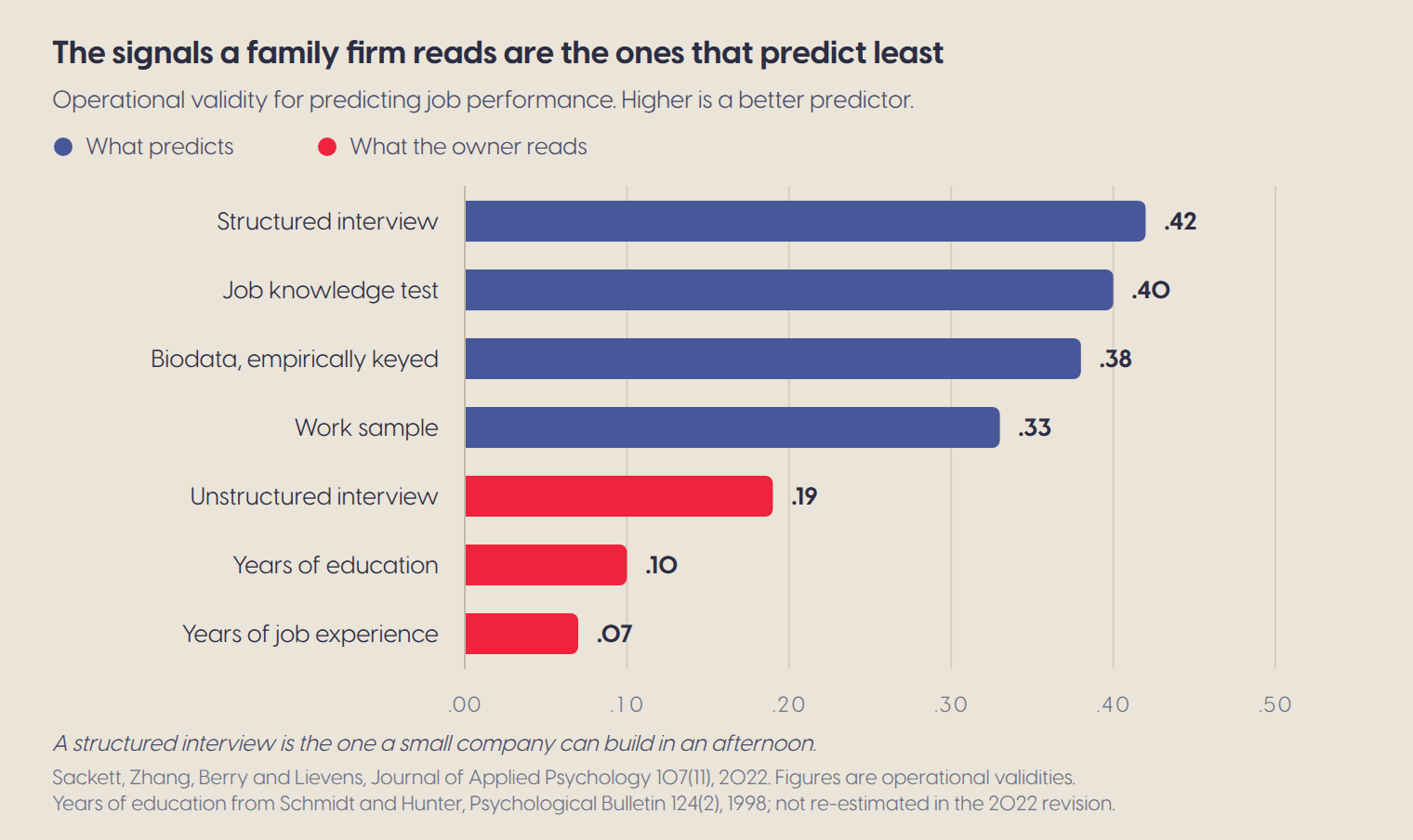
The visible half of that comparison is the part that predicts least. In the most recent major revision of the selection literature, published by Sackett, Zhang, Berry and Lievens in the Journal of Applied Psychology in 2022, the operational validity of years of job experience for predicting job performance is .07. The unstructured interview is .19. Schmidt and Hunter's older estimate for years of education, which Sackett and colleagues did not revisit, is .10. At .07, years of experience account for about half of one per cent of the variance in how somebody performs.
The signals that do work are largely the ones these firms do not use. Structured interviews sit at .42, the strongest predictor in the updated table. Job knowledge tests reach .40, empirically keyed biodata .38, work samples .33. Only the first of those is cheap. Job knowledge tests and work samples need job analysis and content development, and empirically keyed biodata needs a criterion sample most family firms will never have. A structured interview a small company can build in an afternoon.
The stranger then underperforms, and the family draws the wrong lesson
Matthew Bidwell examined seven years of personnel records from the US investment banking arm of one financial services company and published the result in Administrative Science Quarterly in 2011. External hires were paid roughly 18% more than people promoted into the same jobs, performed significantly worse for their first two years, and left at higher rates, voluntarily and involuntarily. The people they beat had less education and less experience. They were also promoted faster once inside.
That is one firm in one industry in one country, and the magnitudes should not be moved to Saudi Arabia. The mechanism can be. Firms that observe their own people accurately learn things about them that no external record conveys, and they pay a premium when they buy from outside that knowledge.
Note the awkward corollary. Bidwell's advantage exists only where the firm is genuinely observing. A company that measures nothing has nothing to weigh against the CV, so the outsider wins on paper by default. That is my inference from his finding, not a result he tests.
Then the loop closes. The expensive chief executive underperforms, departs, and the failure gets read as evidence about the market for talent rather than about the firm. Authority moves back inward. The pipeline that was never built is cited as proof that building one would be futile.
The machinery for producing a promotable insider is thin
Ten per cent of the GCC family firms surveyed by the Pearl Initiative and PwC in 2012 had the head of human resources represented on the board, against 27% for the chief financial officer. The function that would build a pipeline sits below the finance function in board access.
The same survey asked what mechanisms these firms use to manage the moment of succession. Eighteen per cent named a performance appraisal process, against 32% of family firms globally. On entry and exit provisions the split was 12% to 28%. On provision for an impartial third-party mediator, 9% to 24%. That is a measure of succession governance, not of whether these firms appraise their workforces, and it should not be read as the latter. Whether the underlying appraisal machinery exists is a gap in the evidence.
The state has moved into the space regardless. The Human Resources Development Fund, in a statement of February 2026, put its 2025 spending on training, empowerment and mentorship support programmes at more than SAR 8.29bn, reaching over 226,000 establishments, nearly 94% of them micro, small or medium, and benefiting more than two million citizens. Those are inputs and reach, not outcomes. A subsidised course is not the same thing as a company that can tell you which of its people is ready.
What it costs
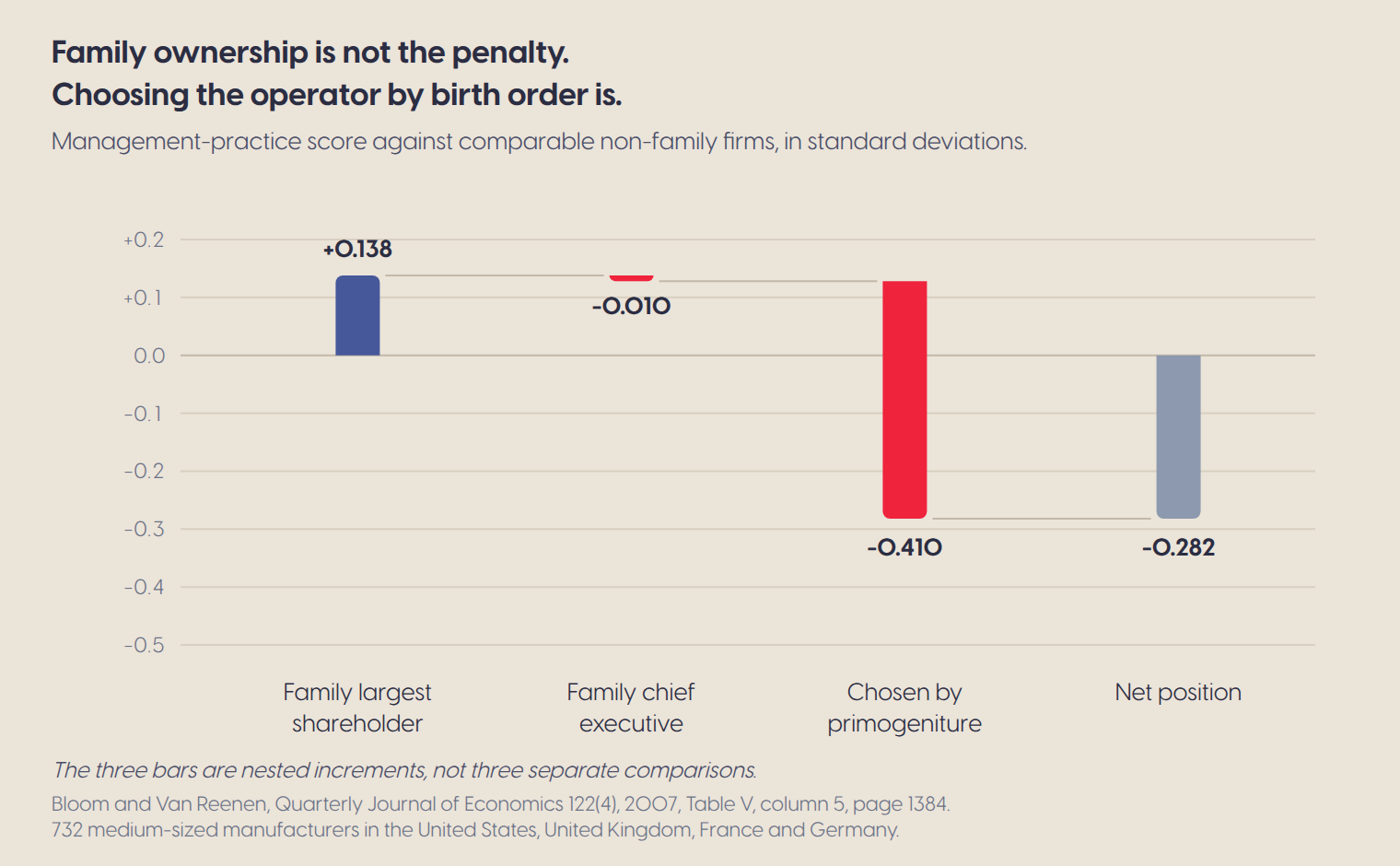
The management-practice literature puts a number on the alternative. Bloom and Van Reenen surveyed 732 medium-sized manufacturers across the United States, United Kingdom, France and Germany. Controlling for country, industry, size, age and workforce composition, family ownership is associated with management practice 0.138 standard deviations above comparable non-family firms. Adding a family chief executive subtracts a further 0.010. Choosing that chief executive by primogeniture subtracts 0.410 more. Family ownership is not the problem. Selecting the operator by birth order is.
The most recent evidence localises the damage where this argument sits. Feng, Henley and Kochanova, working with UK firm-level data and publishing in Small Business Economics, find that family ownership weakens the productivity returns to structured management practice, with a between-firm interaction of −0.532 across 13,032 small and medium enterprise observations and no significant effect among large firms. That is the long-run, cross-sectional estimate; the within-firm equivalent is smaller and not significant. But the shape is the one an owner would predict. The penalty is a small-firm penalty, and professional management in larger firms appears to absorb it.
The objections, taken seriously
The first objection is that governance costs more at the bottom, and the IFC argues it too: "Pushing classic corporate governance on smaller, simpler early-stage companies can be very counterproductive." Its progression matrix does not assume a functioning board before the expansion stage. Compliance overhead behaves largely like a fixed cost, so it falls hardest on the smallest firms. Canadian government analysis put the gap at 1.67 percentage points of operating expenses between firms with fewer than five employees and firms of 100 to 499, which is to say the smallest firms carry roughly six times the relative burden. The jurisdiction is wrong for a Saudi argument; the shape of the cost is not. Owners who reject governance-as-paperwork are reading their own economics correctly. Appraisal rules, defined authority and a stated succession mechanism are a different and cheaper category.
The second objection is that preferring insiders may be rational, and on Bidwell's evidence it often is. This is not an argument for hiring strangers. It is an argument that the trust asymmetry is real and that the firm has chosen the wrong problem: the binding constraint is the absence of internal development, not the absence of external recruitment.
The third is that Saudi practice may be improving faster than critics allow. A 2026 study in the South African Journal of Economic and Management Sciences, surveying a stratified sample of 300 employees across Saudi SMEs in Riyadh, Jeddah and Dammam, finds strategic human resource practices present and significantly associated with employee performance at r = .752. It surveys employees rather than HR functions, and a correlation that size between self-reported practice and self-reported performance in a single instrument invites a common-method caution.
What actually changes it
Three things, none of which requires a board, a charter or a consultant. Give somebody a decision to own, with a budget, a deadline and the right to be wrong. Write down what good looks like before the year starts, for family and non-family employees on the same terms. And when the outside hire does become necessary, run a structured interview against a defined scoring guide rather than a conversation about a résumé, because that is the instrument the evidence supports and the one a small firm can actually build.
A family that does this will still hire from outside sometimes. It will simply stop doing so out of ignorance about the people it already has.
Sources
- Vision 2030 Annual Report 2025, published 25 April 2026. SMEs at 22.9% of GDP, the 2024 actual against a 21.1% target for that year; 2030 target 35%. https://www.vision2030.gov.sa/media/ecdjfopq/vision2030_annual_report_2025_en.pdf
- Sackett, P., Zhang, C., Berry, C. and Lievens, F., "Revisiting meta-analytic estimates of validity in personnel selection: Addressing systematic overcorrection for restriction of range," Journal of Applied Psychology, 107(11), November 2022, pp. 2040–2068. Figures are operational validities, corrected for criterion unreliability. The structured-interview estimate carries the widest spread in the table and should be read as a range. https://doi.org/10.1037/apl0000994
- Schmidt, F. and Hunter, J., "The Validity and Utility of Selection Methods in Personnel Psychology," Psychological Bulletin, 124(2), 1998, pp. 262–274.
- Bidwell, M., "Paying More to Get Less: The Effects of External Hiring versus Internal Mobility," Administrative Science Quarterly, 56(3), 2011, pp. 369–407. Sample: the US investment banking arm of one financial services company, 2003–2009. https://journals.sagepub.com/doi/10.1177/0001839211433562
- Pearl Initiative and PwC, "Family Matters: Governance Practices in GCC Family Firms," 2012. 106 interviews conducted August to October 2012, 40% Saudi. The 18% appraisal figure appears under "Succession, conflict and continuity" and refers to succession-governance mechanisms, benchmarked against the PwC Global Family Business Survey. https://www.pwc.com/m1/en/publications/documents/pipwc-report.pdf
- Human Resources Development Fund, statement of 4 February 2026 on 2025 results, reported by Argaam and Al-Watan. https://www.argaam.com/ar/article/articledetail/id/1877806
- Bloom, N. and Van Reenen, J., "Measuring and Explaining Management Practices Across Firms and Countries," Quarterly Journal of Economics, 122(4), November 2007, pp. 1351–1408. Table V, column (5). The three values are nested increments on a standardised management index against an omitted non-family baseline. https://academic.oup.com/qje/article-abstract/122/4/1351/1850493
- Feng, Y., Henley, A. and Kochanova, A., "When formal management practices meet informal governance: family ownership and productivity in UK firms," Small Business Economics, 2026. Between-firm estimate; SME subsample 13,032 observations. https://doi.org/10.1007/s11187-026-01191-x
- Ryabota, V., Volynets, A., Kravatzky, A. and Carrington, H., "Governance for SME Sustainability and Growth," IFC Private Sector Opinion 43, 2 May 2019. https://documents1.worldbank.org/curated/en/609571567666610488/pdf/Governance-for-SME-Sustainability-and-Growth.pdf
- Tu, J., "Impact of Regulatory Compliance Costs on Business Performance," Innovation, Science and Economic Development Canada, 9 October 2020. Regression estimate with controls; the relative gap is 83.5% and the absolute gap 1.67 percentage points. Underlying data is Statistics Canada's 2011 Survey of Regulatory Compliance Costs. https://ised-isde.canada.ca/site/paperwork-burden-reduction-initiative/en/survey-regulatory-compliance-costs/impact-regulatory-compliance-costs-business-performance-october-2020
- Ainosa, A. and Binti Hussain, I., "Employee perspectives on strategic human resource management practices and their impact on organisational performance in Saudi Arabian SMEs," South African Journal of Economic and Management Sciences, 29(1), 2026. https://sajems.org/index.php/sajems/article/view/6423