

Posted At: Jul 19, 2026 - 171 Views
The most striking insight from four days at Harvard Business School was not about AI's capabilities, but about human behavior. Microsoft launched Copilot to its 62,000-person sales team with strong executive support and an extensive internal campaign. Daily active usage peaked at 22.7 percent, then dropped to 5.1 percent within a month. Even the world's most advanced technology company, using its own product, saw initial enthusiasm quickly fade. This case, discussed in HBS's Generative AI Strategy and Execution program in June, reflects a recurring theme in economic history.
Consider the historical parallel: Edison activated the Pearl Street station in Manhattan in 1882. Thirty-eight years later, electric motors accounted for just over half of mechanical drive power in American factories, and the anticipated productivity surge did not occur until the 1920s. Economist Paul David explained that factory owners replaced steam engines with electric motors but did not change the factory layout. Productivity gains emerged only when factories were redesigned to leverage electricity, allowing machines to be placed where work naturally flowed rather than tethered to a central drive shaft.
The key difference today is speed. Within two years of ChatGPT's launch, 39 percent of American working-age adults had used generative AI, according to research by Alexander Bick, Adam Blandin, and David Deming published by the St. Louis Fed. By comparison, the internet reached 20 percent adoption at the same stage, and the PC took three years. Goldman Sachs estimates that generative AI could increase global GDP by 7 percent over ten years. The diffusion barrier that slowed electricity's adoption is gone. The remaining challenge, as Microsoft experienced, is work redesign. This is a leadership issue and was central to the program.
The program, led by Professors Rajiv Lal and Suraj Srinivasan, followed the classic HBS case method: read the case, discuss it in small groups at 8 am, and defend your position in class. Over four days, we examined nine companies at various stages of AI adoption. These included Coursera identifying where generative AI adds value, Salesforce developing Agentforce and an agentic workforce, Adobe evaluating generative AI's impact on its core business, Unilever building an AI-ready organization, Gamma achieving $50 million in recurring revenue with just 30 employees, Criteo addressing commerce with AI-driven shoppers, Harvey integrating legal AI into core workflows, WorkFabric creating agentic enterprise twins, and Microsoft addressing post-launch challenges. The curriculum also included hands-on work with AI agents, a workflow redesign workshop, and a session with Raffaella Sadun on the future of work.
I left with three key implementation rules.
First, business strategy must lead, with AI serving as an enabler. As Unilever's global digital director states in the case, generative AI is not the strategy itself. The right question is not "what is our AI strategy," but rather, "what is the business trying to achieve, and which aspects should be redesigned based on AI's capabilities?"
Second, adoption requires change management, not just procurement. Microsoft's usage improved only after Copilot was integrated into daily workflows, with the meeting recap feature providing a clear reason for regular use. Sustained adoption depended on visible senior sponsorship, role-specific use cases, and ongoing enablement. Each pause in support led to a decline in usage. Simply purchasing licenses and offering a single training session is as ineffective as attaching an electric motor to a steam-era factory layout.
Third, approach experimentation scientifically. GitHub and Google conducted randomized controlled trials to measure the impact of AI assistance on developer output. This disciplined approach applies to any function: use treatment and control groups, define clear metrics, and measure results over a few weeks. In a rapidly evolving field, planning horizons are short, and systematic small-scale experiments are more effective than large, untested initiatives.
A common objection warrants a direct response. The same researchers who tracked AI's rapid adoption estimate its current impact on US labor productivity at only 0.1 to 0.9 percent, barely noticeable. However, this does not undermine the ten-year outlook; it mirrors the early days of electrification. In 1900, eighteen years after electrification began, productivity gains were minimal because organizational redesign had not yet occurred. Adoption has outpaced any previous workplace technology. As in 1900, the potential payoff now depends on effective management.
This is why I left Boston convinced that the forty-versus-ten comparison is not just a metaphor, but a practical assumption. The differentiation among companies that once took a generation with electricity will now occur within a decade. Success will not depend on having the best model, since that advantage is widely shared, but on who effectively redesigns their work. The key question for any leadership team, including my own, is whether we are truly rebuilding the factory floor or merely replacing the motor.
Sources: Paul A. David, "The Dynamo and the Computer," American Economic Review, 1990; Bick, Blandin and Deming, "The Rapid Adoption of Generative AI," NBER Working Paper 32966 and Federal Reserve Bank of St. Louis; Goldman Sachs Research, 2023; HBS cases "Microsoft Customer and Partner Solutions: The Deployment of Copilot (A)" (626-065) and "Gamma: Slides in the Blink of AI" (826-001); HBS Executive Education, Generative AI Strategy and Execution, June 2026.
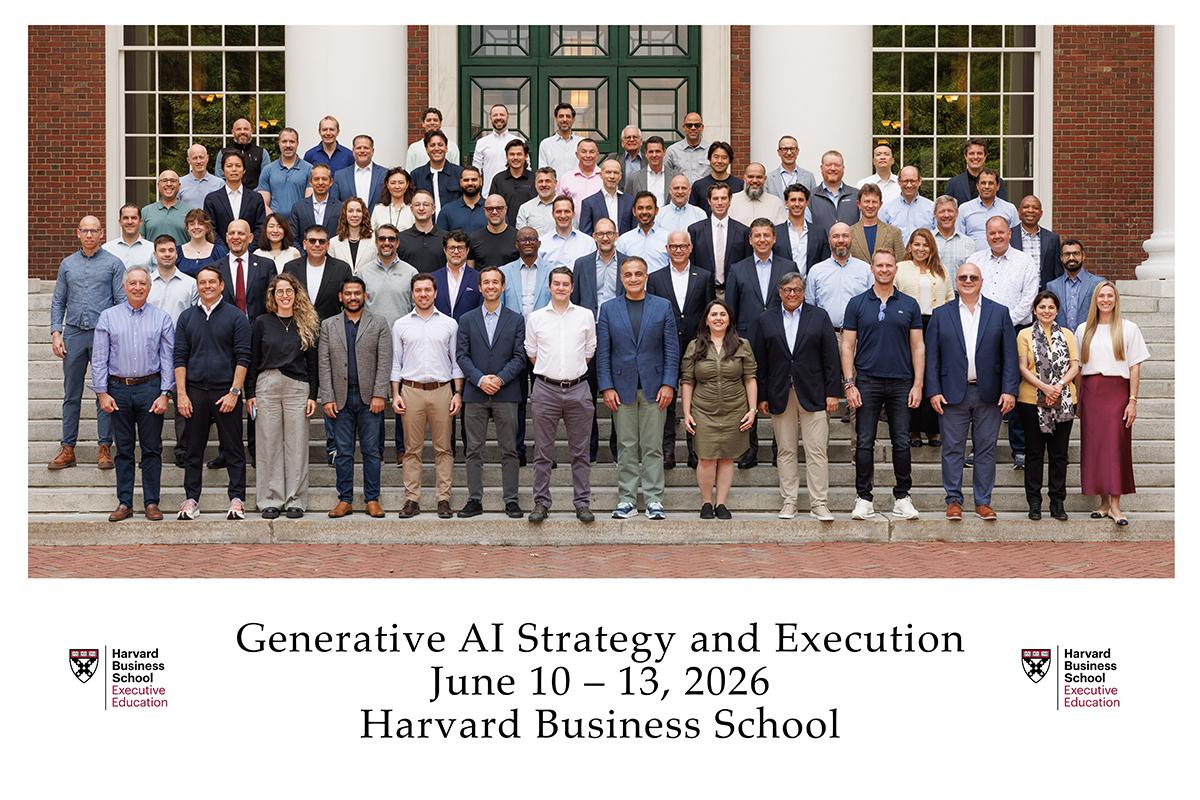
Generative AI Strategy and Execution cohort, Harvard Business School, June 2026.